Pro Tips

My last post, mom math vs. dad math, got more response than anything I've written. The most useful response was a pushback. A reader said, roughly: the problem isn't that men can't do the math. It's that they're raised to expect they won't have to, and a tool that hands a man the answers reinforces exactly that.
She's right. So this post is about what I did that isn't a tool. It's about taking things over, whole, including the part where you have to know.
As I mentioned in that post, I suggest counting the number of times in a week you call your partner to ask what to do. My number was more than I'd like to print. That number measures something specific. It isn't how much you do at home. It's how much you know. Every call is a lookup against a database you don't have a copy of.
This is what I did to get a copy. It took longer than it should have, and it's not finished.
"Just tell me what to do" is the problem
I used to say this and feel generous. It sounds like an offer. It's actually a request.
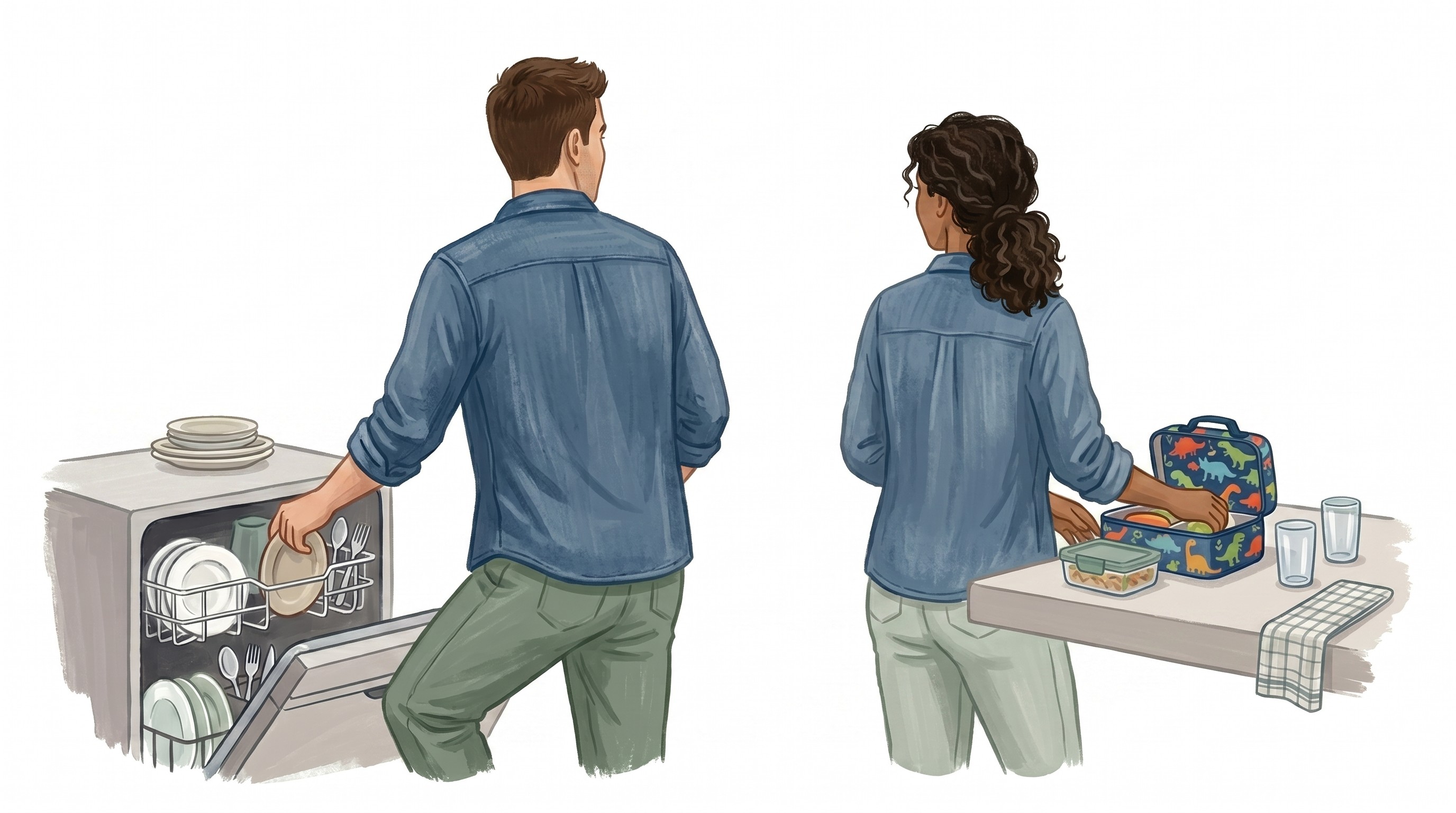
When I asked my wife what to buy, she had to stop what she was doing, picture the pantry, remember what was running low, translate it into names I'd recognize on the shelf, and then wait for the follow-up call from the aisle. I did the driving and the carrying. She did all the thinking, plus the extra work of thinking out loud for me.
In systems terms: I'd volunteered to be a worker node that can't do anything without calling the coordinator. More workers like that don't lighten the coordinator's job. They add to it.
So the first thing I had to stop doing was asking. Not because asking is rude, but because the question "what should I do" routes the work right back to the person I was trying to help.
Take an area, not a task
The thing that actually worked was taking over whole areas, including the knowing, and never handing them back.
Here's mine.
Our daughter's college. Everything about her undergrad is mine now. She picks her own courses; she's old enough. But I'm the one who sits with her each semester to weigh the options, tracking courses each semester and how they add up to a degree over four years. The meal plan. The dorm. Keeping track of Boston's seasons so the right clothes get there before the weather does, and the things from home she didn't know she'd need until she needed them. When she has a problem, I'm the one she calls, and I'm the one who already knows the context. For most of her childhood, that was her mother.
Travel. Every trip our family takes is on me now. Where we stay, how we get there, what each day looks like, what gets packed. That included moving our daughter into her dorm in Boston, which meant learning the exact difference between a Twin and a Twin XL, and coordinating the 90-minute loading dock window the building gave us. It's the first time I've known the answer to "what's the plan" before anyone asked.
The backyard. I took the garden completely. That meant learning Santa Clara's watering schedule, what to do with clay soil, and exactly when the sprinklers are supposed to run. The point isn't that I'm good at it. The point is my wife doesn't think about it anymore. When something needs doing out there, it's my problem before it's hers.
Trash. Compost, recycling, landfill. This sounds like nothing. It is not nothing. It means knowing that greasy pizza boxes go in the green compost bin, not the blue recycling bin, and that the city changed the rules for yard waste. For years I'd carry a bag to the garage and ask which bin. Now I'm the one who knows.
I know how this list reads if you have a seven-year-old. Our daughter is grown and three thousand miles away. There are no permission slips in our house anymore, no lunches, no Girl Scout cookie season. What I took is what's left, and I took it late. My wife ran the hard years alone. That's not a defense of the list. It's the reason the list exists.
None of these are impressive. That's the point. A birthday party, the school's spirit week, the dentist's six-month cadence: these are the areas, and whoever knows them carries them. You don't need to take the biggest one. You need to take one completely.
Do the discovery yourself
The hard part of taking an area isn't the doing. It's the first week, when you realize how much you don't know and the only person who has the answers is the one you're trying to relieve.
The temptation is to ask her to write it all down. Don't. That's the same request in a different format: here is more work, please do it so I can help.
Instead, write the runbook yourself. Look at the last three trips. Read the school's email, the one she's been reading for years. Open the garden shed and figure out what's in it. Google the pizza box.
You'll get things wrong. I put the wrong kind of plastic in the recycling, and on one of our first trips I misjudged the drive time to SFO. That's fine. Being wrong in your own area is still carrying it. Being right by calling her isn't.
What I still haven't taken
Cooking. I've tried several times. I have accepted that this is not going to change.
I say this because the version of this post where I've fixed everything would be a lie, and because the areas I haven't taken are a fair reminder of what she's still carrying. Every household has a list like that. Looking at it honestly is part of the job.
Somewhere for the knowing to live
The deeper problem in our house wasn't willingness. It was that everything lived in one person's head, and getting it out meant more work for that person.
This has a name, the mental load. As I mentioned in my last post, researchers have found that mothers handle over 70% of this invisible household planning. My co-founder Ajantha has written about how to redistribute it from the side that carries it. This is the other side.
Melo is what we built so the knowing has somewhere else to live. My wife puts what's in her head into it. It breaks that down into pieces with enough detail that I can take them without a call from the aisle. When we plan a trip to see our daughter, the itinerary comes out of it, and so does the packing list. Even our grocery list pulls directly from the weekly plan, so I'm no longer calling her from the aisle to ask what's in the fridge.
One test I hold it to, and that the reader I mentioned would hold it to: if I end up depending on the app the way I used to depend on my wife, it has failed. The point is that the knowing moves to me. The app is where it lives while that happens.
If you're the partner who's willing but keeps asking, start with one area. Take all of it. Then give the knowing somewhere to go that isn't her.