
Pro Tips
How to Actually Redistribute the Mental Load
The research and the lived experience point to the same handful of moves — and none of them is "try harder." So, let’s start with what does not work.
What does not work to manage mental load
Let's start with what doesn't work.
Telling yourself to stop overthinking
Asking your partner to ‘help’ more - they are not ‘helping’ if you are both to be running your shared household equally
Yelling at your kids in absolute helplessness because your brain is on overdrive
Crying on the bathroom floor
Continuing to carry it alone because that’s how it is
Not because these things are unhelpful, but because none of them addresses the main issue: you being the only one carrying the mental load of the entire household.
Mental load is not a mindset problem. It's a structural, organizational, and cognitive problem. You can't breathe your way out of carrying 71% of a household's invisible labor.
What does help to redistribute the mental load
Here's what the research — and the people living it — say actually helps.
Name the issue.
You can't redistribute work your partner can't see. Most people can't see it because it's been invisible by design. Naming the load — not as a complaint, but as a description of a real job — is the first redistribution. The word "mental load" exists precisely so this conversation can start. Without a fight. Without blaming. But just recognizing.
Hand off ownership, not tasks.
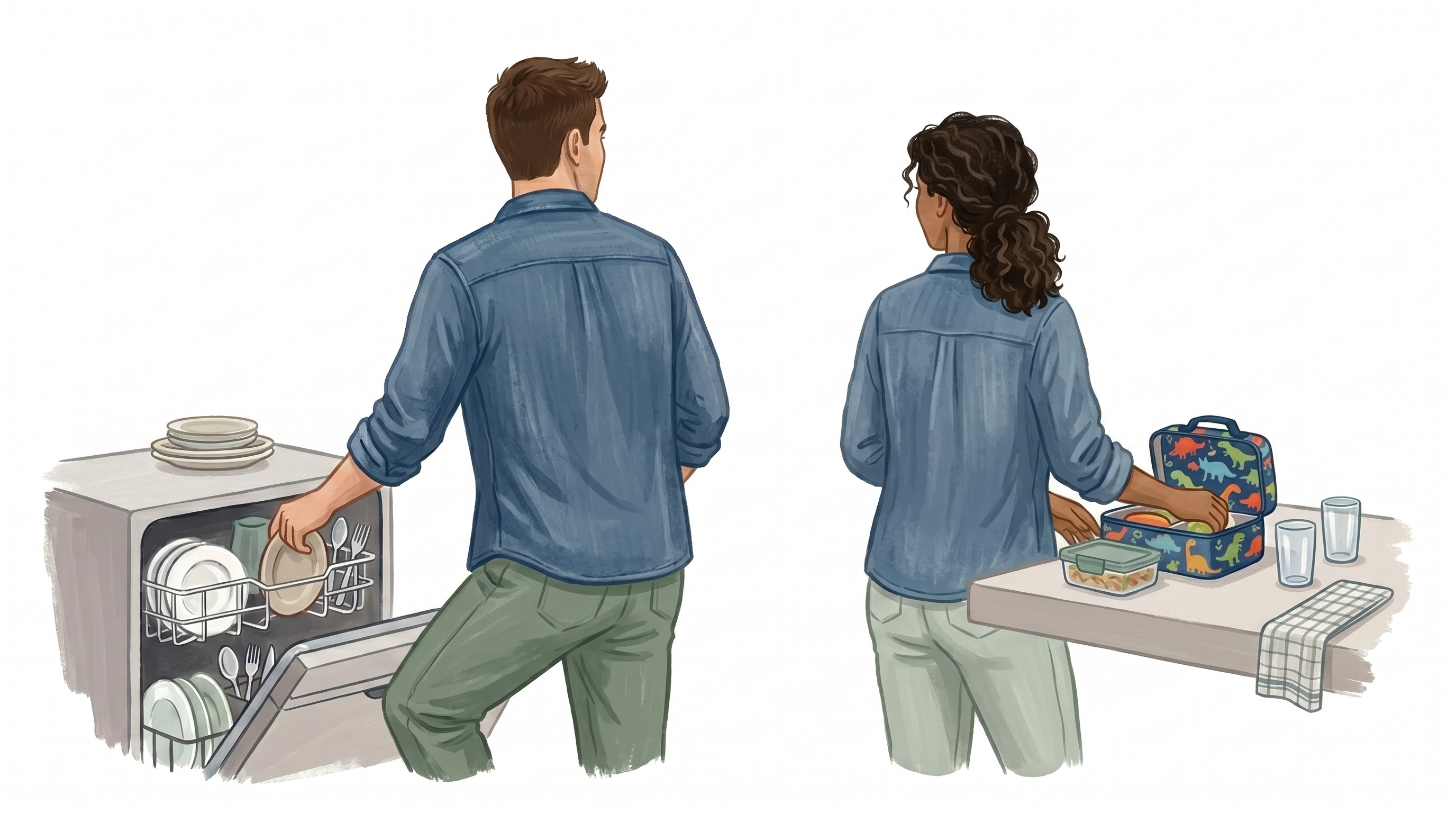
This is the single most important shift. "Remind me to sign the permission slip" keeps you as the manager. "You own school" makes the other person the one who anticipates, decides, and monitors that whole domain. Tasks delegate the doing; ownership delegates the thinking. The latter actually takes weight off your head.
Build the process that doesn't route through you.
A reminder that only fires to you isn't help — it's a notification of your own backlog. The goal is a system where the right person gets the right nudge without you being the middleman.
Use tools that understand context, not just commands.
A blank text box that needs you to structure everything is one more thing to manage. It will keep you in the household project manager role. Plenty of tools promise to keep you more organized. To remind you. But you are already organized, and you already remember everything. That’s not helpful.
What actually lightens the load is a tool that considers you and your partner as whole persons with your own preferences, you own belief systems and ways of doing things. To help with your unique situation you need a tool that can understand your uniqueness. Not one that will apply a one-size-fits-all formula.
You’re better off with a tool that acts like a second brain for each of you. Something you can talk to the way you'd talk to a competent partner — that holds the family's context so your brain is not the only hard drive it lives on.
That last one is where, for what it's worth, we started building Melo. Not as a productivity app — there are enough of those — but as a way to put the thinking somewhere other than one exhausted person's head.